
WMJ Marine
Anchor & Docking
Boat Engine Parts
Boat Furniture
Cabin & Galley
Communication
Electrical Supply
Fishfinder & Sonar
Fishing
Gifts/Holiday
GPS & Chartplotter
Marine Autopilot
Marine Electronics
Marine Instrument
Marine Radar
Marine Safety
Navigation Tool
Plumbing & Pump
Steering & Control
Trailers
Specials
Reman'd & Closeout
How To Order
Contact Us
Gorvernment Order

Order Status
Testimonials
Affiliate Program
Privacy Policy
Company Info
Site Map
Send me more info
Resources
Links
Link to Us
Shopping Cart


_________________
Would you like to receive
our Free Newsletter
 for Special offers?

Email Address:


HACKER SAFE certified sites prevent over 99.9% of hacker crime.


WMJ Marine
How to Order Shopping CartContact Us Shipping Info International OrderOrder Status
Home > Marine Electronics >

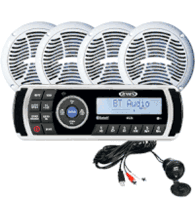
Marine Stereo DVD CD System


pad

Installation Consideration for Marine Stereo System

Music is a vital part of boating pleasure for many people. But obtaining high-quality music on a boat is sometimes difficult. For optimum sound, you need more than just a good stereo, you need high quality marine speakers that are properly installed. Follow these principles to ensure the best quality sound on your boat, and to save yourself future repair and replacement work.

Flush Mount or Box Speakers?
Speakers that require a cutout (flush mount) and speakers that don't. Box speakers have the obvious advantage that they don't require you to cut a hole in your boat. But they take up more space than flush mount speakers and can be cumbersome in a busy cockpit.

Box speakers typically are installed in an acoustically-designed enclosure around the driver to provide a structured resonance space for optimum performance. They are easy to install and you can feel comfortable that the sound you heard in the showroom will be similar to the sound you hear on your boat.

You might choose flush mount speakers because they are attractive, can be installed in tight spaces and out of the way on most activity. However, proper mounting can be tricky. Speakers work by moving a diaphragm (cone) back and forth to move air and generate sound. An air space that is too small will inhibit movement of the diaphragm and result in a serious loss of low frequency response. Also, make certain there is no air path between the front and rear of the speaker. When the diaphragm moves forward, air will rush into the vacuum behind the speaker instead of traveling to your ear, again resulting in loss of low frequency response.

Waterproof Speakers a Must
Home or automobile speakers have steel frames and grilles, exposed copper wires and, in some cases, paper cones. All of these features are a problem on a boat: steel rusts, copper corrodes, and paper dissolves. Since salt air is the main environmental problem, waterproof speakers should be used below decks as well as in the cockpit.

Installation
Speakers are directional. When installing speakers on deck, be careful to point them toward the place your ears will be. Below deck, direction is less crucial, since there are many reflective surfaces to contain the sound.

We recommend using 18-gauge wire when connecting the system. Tinned marine wire is best, although doorbell wire works well. It is inexpensive, comes in pairs, and isn't stranded, so there is less surface area to corrode. Since copper wire is very vulnerable to corrosion, you should seal all wires between the insulation and soldered area. Liquid electrical tape is excellent for this application.

Make sure positive terminals on speakers are matched with the positive side of the stereo output; i.e., they are connected "in phase." Speakers that are "out of phase" because some connecting wires are reversed will result in some tones canceling each other out and an audible reduction in sound quality.

Speakers connections out of phase will not physically harm the stereo or the speakers. If you are not sure which speaker terminal is positive, place a AA or AAA battery across the terminals. When the positive terminal of the battery touches the positive terminal of the speaker, the speaker cone will move forward.


Placement
Until now, installing speakers within 5 feet of compasses, autopilots or other navigation gear was a problem. The magnetic flux produced by an operating speaker could affect compass readings and any other equipment interfaced with the compass. Now, with poly-planarŪ's exclusive new ultra-low magnetic field speakers, maintaining the 5 foot distance is no longer necessary. The low magnetic field technology uses a canceling magnet and a shielded enclosure to reduce the magnetic flux caused by the speaker. Ultra-low magnetic field speakers in poly-planarŪ's line include all of the 4000 Series Round Integral Grille (MA4054, 4055, 4056 and 4600) and the MA5500 rectangular flush mount models, an ideal upgrade for the MA505 popular with many boaters worldwide.

Installation Considerations
Speakers are directional: Point them at your ears. A speaker produces the best sound along its central axis. Sound radiates in a pattern approximately 45 degrees off the main axis. If you are not in this radiating zone, the sound must bounce off a reflecting surface in order to be heard. Below deck, this is usually not a problem, as space is typically quite small and there are plenty of reflecting surfaces. However, above deck, reflecting surfaces are limited. When mounting speakers, try to imagine where your ears will be located when listening, and try to point the speakers toward your ears. Location affects both the volume and the quality of the sound you hear, since different frequencies disburse with different efficiencies.

Flush-mount speakers need air behind them. Don't choke your sound. In general, more air is better. If you have less than one cubic foot of air behind your speakers, you are at risk of inhibiting the bass response. Sound is a compression wave which is created when the speaker cone moves in and out. If the air cavity behind the speaker is too small, cone movement is inhibited by the vacuum created in the cavity when the cone moves outward. Likewise, pressure is created when the cone moves inward, which also slows cone movement. The result is a loss of bass response, since low frequencies re-quire the largest air movement.

Separate the air in the front of the speaker from the air behind it. Don't use your speaker in "free air". As a speaker cone moves forward, it creates positive air pressure in front of the cone, which eventually reaches your eardrums and enables you to hear the sound. At the same time, the forward movement of the cone also creates a vacuum behind the cone. If there is no baffle (wall) separating the front of the speaker from the back of the speaker, the positive air pressure at the front of the cone will rush around the edge of the speaker and fill in the vacuum behind the cone. This positive pressure will not reach your ear, which has the effect of dramatically reducing bass response. This condition, known as "free air response", is the reason why unmounted speakers may lack bass response and sound "tinny."

Your speakers should be able to handle more power than your stereo can produce, so you don't blow your speakers. A speaker's power handling specification is a measure of the point at which the speaker will fail if more than the specified power is applied. On a stereo, the power specification is the maximum amount of power the stereo will produce. If the stereo can produce more power than the speakers can handle, you run the risk of blowing out your speakers at high volume. If you have a high power stereo and low power speakers, a useful precaution is to wire an in-line fuse to one side of each speaker line. [To calculate the size of the fuse, divide the speaker's RMS watts by four. The square root of that quotient equals the size of the fuse required.] Power ratings can be confusing because power can be specified in several ways, all of which are expressed in watts. See Power-in the Glossary for more information. Use RMS power for comparison purposes whenever possible. Be sure to compare the per channel power of the stereo with the per speaker power of the speakers. Note that when two or more speakers are connected to the same channel of the stereo, the speakers will share the power - two 20 watt speakers will handle a total of 40 watts, three 20 watt speakers will handle 60 watts, etc. You do not gain low power sound quality by increasing the maximum power handling of your speakers. A one-watt signal will not sound any better played on 100 watt speakers than it will on 10 watt speakers. The most critical factor affecting sound quality is the size of the main cone: the larger the cone, the better the bass response.


pad
JBL Stereo System
pad
PolyPlanar Stereo System
JBL Stereo System
pad
pad
PolyPlanar Stereo System
pad
pad
pad
Aquatic Stereo System
pad
BOSS Stereo System
Aquatic Stereo System
pad
pad
BOSS Stereo System
pad
pad
pad
Jensen Stereo System
pad
Infinity Stereo System
Jensen Stereo System
pad
pad
Infinity Stereo System
pad
pad


***The price is subject to change at anytime without any notice

_______________________________________________________________________________
Dear Customer

We are proud to serve you with any assistance we can provide via email ask@wmjmarine.com or toll free number at
1-877-330-9758.

You will find the vast choices of marine products including GPS (including Garmin GPS, Magellan GPS, TomTom GPS), Fish Finder, Marine Radar, Marine Electronics, VHF radio, Marine Supply,  Boat Part from major brands


  HACKER SAFE certified sites prevent over 99.9% of hacker crime.

This Web site has chosen one or more VeriSign SSL Certificate or online payment solutions to improve the security of e-commerce and other confidential communication


We accept all major credit cards & Paypal

All personal information you submit is encrypted and 100% secure

We offer online shipment tracking


UPS Shipping Cost can be seen during the checkout, right before submitting the order


We use the Secure-Server that supports industry-standard 128-bit SSL encryption for your safe online transaction.

WMJ Marine offers a variety of marine supply and boating equipment for your exciting boating life including GPS ( Garmin gps, Magellan gps, Lowrance gps, Furuno gps, Tomtom GPS, Raymarine gps), Fish finder (Furuno Fishfinder Humminbird fish finder, Garmin fish finder, Eagle fish finder, raymarine fishfinder, Lowrance fish finder, gps fish finder),  marine electronics, marine VHF radio (Icom Radio, Standard Horizon Radio, Uniden VHF),  marine radar (Furuno radar, Sitex Radar, Raymarine Radar, JRC Radar, Simrad radar, Northstar radar ), windlass ( maxwell windlass, Lewmar windlass, powerwinch, Boat Anchor, Anchor Winch, Trailer Winch), Navigation chart ( Navionics, Cmap, Garmin Blue chart ), Nobeltec Navigation software, Inverter ( Xantrex Inverter Charger, Voltage converter, marine battery charger), Marine Search Light, Marine Spotlight, Trolling motor ( minn kota trolling motor, motorguide trolling motor ), boat part ( trim tab, boat starter, boat propeller), model ship, Night vision, Night vision Goggles Night vision binocular, night vision riflescope, marine part, marine safety (EPIRB, Lift Jackets, Life Vest, watermaker, Marine Light, Night vision optics, Night vision scope, Marine Autopilot, Marine Chart ). 

                Marine Electronics, Fish Finder, Boat Part, Inverter Store

To speak to someone about your marine supply or  boating equipment right now,
just call toll free
1-877-330-9758. We will be happy to answer immediate questions about our boating equipment and marine supply.

You can also email ask@wmjmarine.com  

Thank you for visiting WMJ Marine for your boating equipment and marine supply !


If you have any question, please let us know at ask@wmjmarine.com
We respond to your email within Hours. or Leave us a message at Toll Free (877)330-9758
or Fax at (501)631-4759


Related Products

GPS/ChartPlotter
GPS/ChartPlotter


GPS Accessories
GPS Accessories


Fish Finder & Sonar
Fish Finder & Sonar


Fish Finder Accessories


Marine Radar & Chart Plotter


GPS & Radar Antennas


GPS Chartplotter Fishfinder Combination


Radar Accessories
Radar Accessories


Marine Instruments
Marine Instruments


Marine Chart & Mapping Software


Satellite TV & Phone


Satellite Internet & Phone


Handheld VHF/UHF Radio


Mounted VHF Radio
Mounted VHF Radio


SSB Radio
SSB Radio


DVD & TV Monitor
DVD & TV Monitor


Marine Hailer
Marine Hailer


Marine Fax
Marine Fax


Automatic Identification System


Weather Fax
Weather Fax


Weather Monitoring
Weather Monitoring


Instrument Mount
Instrument Mount


Electronic Compass
Electronic Compass


Marine Display
Marine Display


GMDSS
GMDSS


Home | Anchor & Docking | Boat Engine Parts | Boat Furniture | Cabin & Galley | Communication | Electrical Supply | Fishfinder & Sonar | Fishing | Gifts/Holiday | GPS & Chartplotter | Marine Autopilot | Marine Electronics | Marine Instrument | Marine Radar | Marine Safety | Navigation Tool | Plumbing & Pump | Steering & Control | Trailers | Specials | Reman'd & Closeout | How To Order | Contact Us | Gorvernment Order
Our Company Policy | Privacy Policy | Shopping Cart

Marine Supply Specialist, Carlsbad, Ca, USA - WMJ Marine Corporation

Copy Right: WMJ Marine Corporation 2004-2006